arxiv.org·2026/10/23
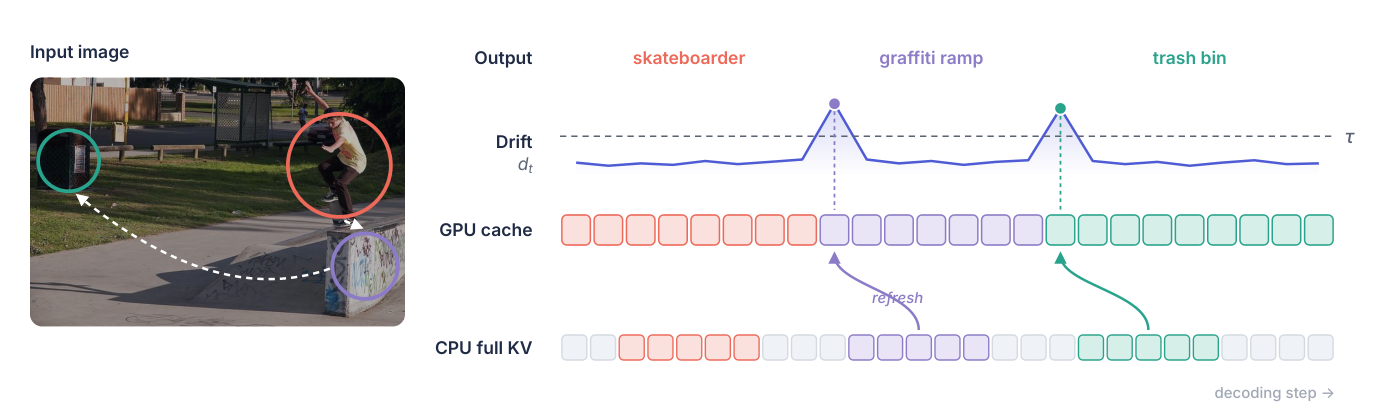
针对多模态大模型长文本生成中一次性KV选择随注意力漂移失效的问题,文中量化显示:在64条目/头预算下,连使用完整答案注意力的oracle一次选择在DetailCaps上也只有0.44–0.52的ROUGE-L一致性。RCR把重选的“何时与在哪层”交给drift信号,把“多频繁”交给逐样本速率控制器,并用少量SVD旋转key通道做低秩检测、仅对候选子集精确重选、触发决策留在GPU。作者报告,同一配置在Qwen2-VL、LLaVA-NeXT、Qwen3-VL的DetailCaps与TextCaps六项设置中,有五项超过InfiniGen 1.6–3.8个ROUGE-L点,第六项无显著差异,且距每步精确重选不超过1.7点;drift选时优于等速率随机与更高频率周期刷新。预注册视频描述中漂移样本间更均匀,RCR对Qwen2-VL与InfiniGen持平、对Qwen3-VL领先,但不再优于固定阈值。作者也指出优势随预算增大而缩小,且仅估算流量、未实测端到端延迟。
为什么重要 KV 卸载推理中 ρ 直接映射带宽预算;5c 读取量、1/4 体积检测器与 GPU 侧判定可直接进工程实现。适合 做 KV 卸载/长上下文推理 infra 的工程师与多模态生成研究员
多模态 LLM 的 KV cache 压缩通常在 prefill 阶段一次性选择要保留的视觉 tokens,并在整个生成过程中复用该选择。
我们表明,这种一次性选择在长文本生成上受到严重限制:在详细图像描述中,即使是一个使用未压缩答案注意力进行选择的 oracle,也仅与未压缩输出达到 0.44-0.52 的 ROUGE-L 一致性,因为模型读取的证据会随着描述展开而移动。
每当注意力漂移出已保留集合时就重新选择,是自然的补救方法,但我们发现固定漂移阈值会系统性失效:漂移幅度在不同样本之间不可比较,因此低漂移样本几乎从不刷新,尽管它们受益最大。
我们提出 Rate-Controlled Refresh(RCR),让漂移决定何时以及何处重新选择,同时由逐样本控制器调节刷新频率,并结合低秩漂移检测器、候选受限重选择,以及保持在 GPU 上的决策。
在所有模型和任务使用同一设置的情况下,RCR 在六个模型-任务设置中的五个上超过逐步检索方法 InfiniGen 1.6-3.8 个 ROUGE-L 分,在第六个上没有显著差异,同时与精确逐步重选择保持在 1.7 分以内,并具有相当的每步估计数据移动量和 4x 更小的 GPU 驻留检测器。
在 DetailCaps 上,漂移选择的刷新时机在相同刷新率下优于随机时机,甚至在更高刷新率下也优于周期时机,提升 2.0-5.0 分。
在预注册的视频描述中,漂移在样本之间较为均匀,RCR 在 Qwen2-VL 上与 InfiniGen 相当,并在 Qwen3-VL 上超过它,但在最接近的测试速率下不再优于固定阈值,这与诊断一致;对象级评估显示,RCR 在三个模型中的两个上相对未压缩输出取得了高于 InfiniGen 的 object F1。
KV cache compression for multimodal LLMs usually selects the visual tokens to keep once, at prefill, and reuses that selection for the whole generation.
We show that this one-shot selection is severely limited on long-form generation: on detailed image description, even an oracle that selects with the attention of the uncompressed answer reaches only 0.44-0.52 ROUGE-L agreement with the uncompressed output, because the evidence the model reads moves as the description unfolds.
Re-selecting whenever attention drifts out of the kept set is the natural remedy, but we find that a fixed drift threshold fails systematically: drift magnitudes are not comparable across samples, so low-drift samples are almost never refreshed although they benefit the most.
We propose Rate-Controlled Refresh (RCR), which lets drift decide when and where to re-select while a per-sample controller regulates how often, combined with a low-rank drift detector, candidate-restricted re-selection, and a decision that stays on the GPU.
With one setting for all models and tasks, RCR outperforms the per-step retrieval method InfiniGen by 1.6-3.8 ROUGE-L points on five of six model-task settings with no significant difference on the sixth, while staying within 1.7 points of exact per-step re-selection, with comparable estimated data movement per step and a 4x smaller GPU-resident detector.
On DetailCaps, drift-chosen timing beats random timing at the same refresh rate and periodic timing even at a higher rate, by 2.0-5.0 points.
On pre-registered video description, where drift is homogeneous across samples, RCR is on par with InfiniGen on Qwen2-VL and exceeds it on Qwen3-VL but no longer beats a fixed threshold at the nearest tested rates, consistent with the diagnosis; object-level evaluation shows that RCR achieves higher object F1 against the uncompressed output than InfiniGen on two of three models.
oracle 上限
32 槽/头,答案注意力打分
胜 术语解释每解码步用 32 个 SVD 偏斜键通道投机注意力的 KV 检索法,本文最强基线
5/6 设置,CI 不含零
距 exact 每步
LLaVA DetailCaps 反超
检测器体积
Np/16 vs 术语解释每解码步用 32 个 SVD 偏斜键通道投机注意力的 KV 检索法,本文最强基线 Np/4
实际刷新率
目标 ρ=0.4
注释 · 保真度=对未压缩输出的 ROUGE-L F1;oracle 用未压缩答案的注意力打分出自 摘要、§3、§6
注释 · Qwen2-VL DetailCaps,按各样本平均漂移三等分取最低组;高漂移组各方均在 .473–.484出自 §4、§6.1 图 2
EVIDENCE / METHODS
表格
| 设置 | Exact 每步 | |||
|---|---|---|---|---|
| Qwen2 DetailCaps | .388 | .570 | .598 | .613 |
| Qwen2 TextCaps | .626 | .779 | .816 | .826 |
| LLaVA DetailCaps | .371 | .451 | .485 | .478 |
| LLaVA TextCaps | .680 | .773 | .811 | .822 |
| Qwen3 DetailCaps | .409 | .560 | .565 | .571 |
| Qwen3 TextCaps | .505 | .733 | .750 | .767 |
注释 · 预算 64 条/头;较
原版排版与图表 · 手机无法内嵌时可在浏览器打开。PDF 插件内选文不能传给网页助手。